
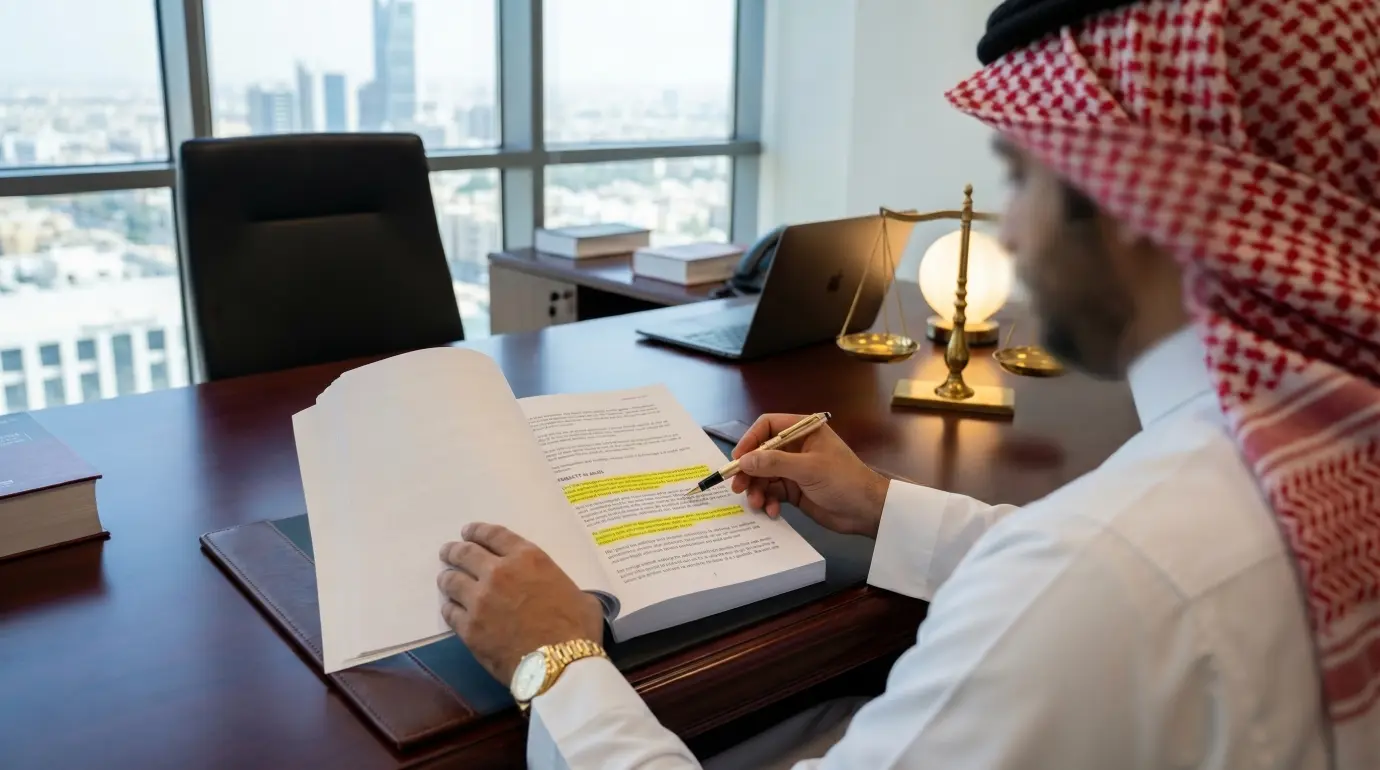
Guide to Penalty Clauses in Saudi Contracts 2026 | Rules & Conditions
The penalty clause in Saudi contracts legally known as "liquidated damages" is the primary safety valve to protect the rights of parties and ensure the execution of obligations on time. With the massive legislative development and the issuance of the Civil Transactions Law, determining compensation in advance has become an indispensable necessity in commercial and civil transactions. Whether you are a contractor, supplier, employer, or investor, incorrect drafting of this clause may render it void or subject to reduction by the judge. In this comprehensive guide, the experts at Mahmoud Al-Shangiti Law Firm in Jeddah lay out the precise legal details of the rulings on penalty clauses in construction, supply, and labor contracts for the year 2026, to serve as your primary reference in protecting your business.
The Concept of the Penalty Clause Under the Saudi Civil Transactions Law
A penalty clause is a prior agreement between contracting parties specifying the amount of financial compensation the breaching party (whether by non-performance or delay) is obligated to pay the other party. The Saudi Civil Transactions Law has settled the legality of this procedure, allowing contracting parties to determine the compensation value in advance within the original contract or in a subsequent agreement.
The primary goal of a penalty clause is not to punish the breaching party as much as it is to "remedy the harm" expected to be inflicted on the damaged party, and to spare them the burden of proving the amount of damage before the courts. Damage is presumed to have occurred once the breach happens unless the breaching party proves otherwise.
Mandatory Rules: When Does the Judge Have the Right to Cancel or Reduce the Penalty Clause?
A common misconception in the business environment is that the penalty clause is absolutely binding and cannot be altered. The statutory reality is that the Saudi judiciary possesses wide discretionary power to intervene in the penalty clause to achieve justice and prevent unjust enrichment. The penalty clause cannot be claimed if the debtor proves that the creditor suffered no damage.
| Case for Judicial Intervention | Judge's Position on the Penalty Clause | Legal Justification (Per the Law) |
|---|---|---|
| Absence of Damage | Complete cancellation of the penalty clause; no compensation is due. | If the debtor proves that the creditor suffered no material or moral damage from the breach. |
| Highly Exaggerated Penalty Clause | Reducing the penalty clause value to correspond with the actual damage. | Compensation must not be a means of unjust enrichment at the expense of the other party. |
| Partial Performance of Obligation | Reducing the penalty clause in proportion to the part that was executed. | Justice requires rewarding the debtor for what they accomplished and reducing the fine for total breach. |
| Damage Exceeds the Clause Value | Increasing the compensation value, provided "debtor's fraud or gross negligence" is proven. | Protecting the creditor from the debtor's evasion if they intentionally caused harm and hid behind the penalty clause ceiling. |
First: Rulings on the Penalty Clause in Construction Contracts
The construction sector is one of the sectors that relies most heavily on penalty clauses, due to the complexity of its obligations and their connection to a strict timeline and subcontractors. The penalty clause in construction contracts is often divided into two parts:
- Delay Fine (Penalty clause for delay in execution): It is usually calculated as a percentage for each day or week of delay (e.g., 1% for each week of delay, with a maximum of 10% of the total contract value in government contracts according to the Government Tenders and Procurement Law, while in private contracts it is subject to the parties' agreement). This clause does not exempt the contractor from their obligation to deliver the project.
- Fine for Non-Execution or Defective Execution: If the contractor withdraws or executes the work with poor specifications that differ from the approved plans, the owner has the right to claim the penalty clause as compensation for the cost of contracting with an alternative contractor and repairing the defects.
Important Note for Contractors: If the delay is resulting from force majeure (natural disasters) or due to the owner's own delay in disbursing financial payments or handing over the site, the penalty clause is not due, and the contractor has the right to claim a time extension.
Second: The Penalty Clause in Commercial Supply Contracts
The nature of supply contracts differs from construction in that the element of "time" may be the fundamental essence of the contract (such as supplying food items tied to a specific season, or supplying equipment to operate a factory). Therefore, the penalty clause here carries a crucial commercial character.
In commercial and supply contracts, if the contract includes a penalty clause for late delivery, the mere arrival of the deadline without delivering the goods places the supplier in a state of "default" requiring the activation of the penalty clause without the need for prior notice (if the contract explicitly states so). In government supply contracts, the law restricts the delay fine to not exceed (6%) of the supply contract value. In the private sector, the clause must be drafted in a way that ensures coverage of production halt losses or missed profits for the buyer.
Third: The Penalty Clause in Employment and Labor Contracts
In the Saudi Labor Law, the penalty clause takes on a different dimension aimed at balancing the employer's right to protect their establishment and the worker's right not to be subjected to arbitrary conditions. The penalty clause in employment contracts appears in basic forms, including:
1. Compensation for Unlawful Termination (Article 77)
Article 77 is the most prominent application of the statutorily stipulated penalty clause. If one of the parties terminates the contract for an illegitimate reason, and the contract does not contain a specific text for explicit compensation (a penalty clause with specified amounts), the system imposes mandatory compensation (15 days' wage for each year for indefinite contracts, and the wage of the remaining period for definite contracts). If the parties agree on a penalty clause with a specific amount in the contract, it is applied provided it is not unfair to the worker.
2. Non-Compete and Non-Disclosure of Secrets Clause (Article 83)
To protect trade secrets, the employer has the right to include a "non-compete clause" restricted by time (maximum two years), place, and type of work. For this clause to be effective, it is advisable to draft an explicit "financial penalty clause" that the worker is obligated to pay if they violate the non-compete clause after the end of the employment relationship, making it easier for the employer to claim compensation before labor courts without getting into the complexities of proving the actual volume of damage.
3. Recovery of Training Costs
If the employer invests large sums in training and qualifying the worker, they have the right to place a penalty clause obligating the worker to refund the training expenses or part of them if the worker resigns before completing the agreed-upon period to work after the training.
The Importance of Professional Legal Drafting of the Penalty Clause
The penalty clause is a double-edged sword; drafting it poorly or in a highly exaggerated manner makes it vulnerable to cancellation by the judiciary, and drafting it leniently makes it non-deterrent. Precise drafting requires linking the clause to the type of breach (delay, poor execution, disclosing secrets) and determining its calculation method with unambiguous clarity.
Why Do You Need to Hire a Specialized Law Firm?
We at Mahmoud Al-Shangiti Law Firm in Jeddah realize that contracts are the governing constitution for your business. We draft, review, and audit all types of commercial and labor contracts, ensuring the drafting of airtight penalty clauses that comply with the Civil Transactions Law and protect your financial rights entirely against any stalling or breach. In the event of a dispute, we litigate vigorously to activate those clauses before commercial, labor, and general courts.
Are you about to sign a contract for massive sums and fear the other party's stalling?
Do not leave your rights hostage to good intentions or ready-made contract templates that may lack legal protection. A single mistake in drafting the penalty clause could cost you massive losses and hinder your business. Contact the contract drafting team at Mahmoud Al-Shangiti Law Firm in Jeddah now to fortify your business with airtight legal contracts.