
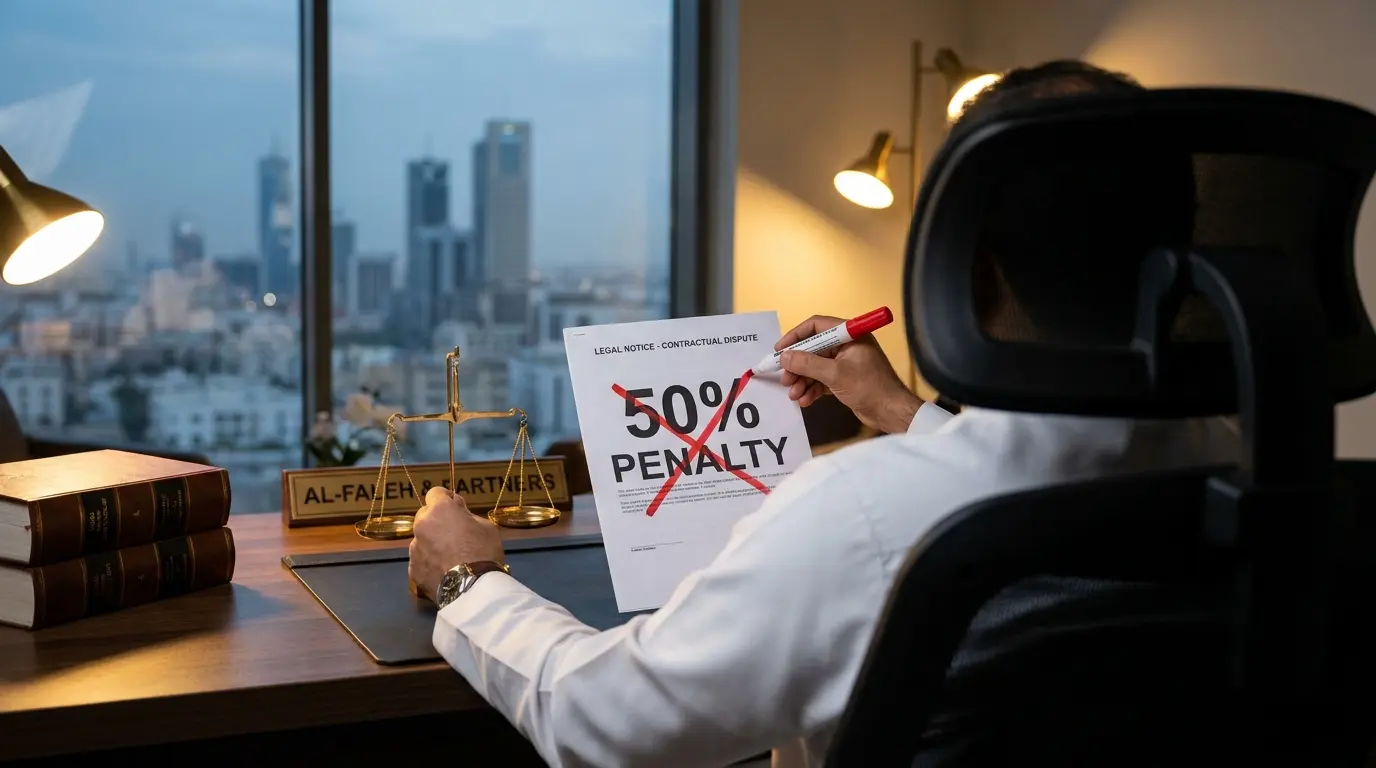
Reducing an Exaggerated Penalty Clause: When Does the Saudi Judge Intervene? 2026
Many contractors, suppliers, and even individuals fall into the trap of signing contracts containing arbitrary clauses, causing losses to multiply at the slightest delay, and finding themselves demanded to pay 50% or more of the contract value as a fine. Here, a crucial question arises: Is an exaggerated penalty clause absolutely effective and binding? The truth that many ignore is that the Saudi Civil Transactions Law did not leave parties at the mercy of arbitrary conditions. Instead, it granted the judiciary the authority to intervene to achieve justice and prevent unjust enrichment. In this article, the experts at Mahmoud Al-Shangiti Law Firm in Jeddah explain when and how the judge intervenes to reduce the penalty clause or annul it completely to lift the injustice off you.
The Judge's Discretionary Power in the Civil Transactions Law
The jurisprudential and statutory rule in Saudi Arabia states that "the contract is the law of the contracting parties," but this rule is not absolute if it contradicts the principles of justice and fairness. The law has guaranteed the Saudi judge wide discretionary power to intervene in "agreed compensation" (the penalty clause) and modify it upwards or downwards, based on the volume of actual damage inflicted on the other party, to prevent the use of contracts as a means of extortion or illicit enrichment.
To gain a deeper understanding of the general rules and the statutory basis upon which compensation is built in various contracts (labor, construction, supply), you can refer to our comprehensive reference article: Guide to Penalty Clauses in Saudi Contracts.
Cases Where the Judge Intervenes to Annul or Reduce the Penalty Clause
The judge does not intervene spontaneously, but upon the request of the harmed party (the debtor of the compensation). The following table illustrates the statutory cases where the judge has the right to intervene by the force of law:
| Case (Incident) | Judicial Action Taken | Statutory Basis and Justification |
|---|---|---|
| Absence of Actual Damage | Completely annulling the penalty clause and exempting the debtor from payment. | No compensation without damage. If you prove your delay or breach caused no loss to the other party, the penalty clause is dropped. |
| Exaggerated (Arbitrary) Penalty Clause | Reducing the penalty clause to correspond with the volume of real damage. | The penalty clause was set to "remedy damage," not for "punishment or enrichment." If the agreed compensation far exceeds the damage, it must be reduced. |
| Partial Execution of Obligation | Reducing the fine proportionately to what was completed of the contract. | It is a matter of justice not to penalize someone who executed 80% of the project with the same fine as someone who executed nothing. |
The Principle of "It is Impermissible to Agree to the Contrary"
One of the most important guarantees provided by the Civil Transactions Law is that it considered the debtor's right to request the "reduction of an exaggerated penalty clause" as part of public policy. In other words; even if your contract includes a clause stating: "The second party acknowledges their obligation to pay the penalty clause in full without resorting to the judiciary or requesting its reduction," this clause is considered absolutely null and void, and is not recognized before the judge.
Legal Procedures to Challenge a Penalty Clause
If the other party files a lawsuit demanding you pay the penalty clause amount, you must adopt an offensive defense strategy based on the burden of proof:
- Proving Force Majeure: If the breach was due to circumstances beyond your control (disasters, sudden government decisions), the obligation to compensate is dropped.
- Pleading Absence of Damage: Submitting evidence and documents proving that the complaining party incurred no material losses due to your delay.
- Requesting the Appointment of an Engineering or Accounting Expert: To demand an assessment of the "actual" damage in numbers, and comparing it to the exaggerated penalty clause value to force the court to reduce it.
The Role of the Contracts and Litigation Lawyer in Saving Your Financial Position
Facing opponents before commercial or general courts requires drafting professional response memorandums based on judicial precedents and the texts of the Civil Transactions Law. Through the Litigation and Arbitration department at Mahmoud Al-Shangiti Law Firm in Jeddah, we undertake pleading on your behalf to ward off unfair and exaggerated penalty clauses. We also always advise prevention over cure by drafting and auditing your contracts in advance through our Contracts and Consulting service to ensure you are not entangled in arbitrary clauses from the start.
Are you being demanded to pay a massive and unfair penalty clause threatening your business?
Do not surrender to the other party's threats and do not pay exaggerated fines unjustly. The Saudi system stands by your side whenever arbitrariness is proven. Contact the litigation experts at Mahmoud Al-Shangiti Law Firm in Jeddah now to study your contract, assess the volume of actual damage, and begin the challenge procedures to reduce or annul the penalty clause by the force of law.
⚖️ Request Your Judicial Consultation Now to Protect Your Money