
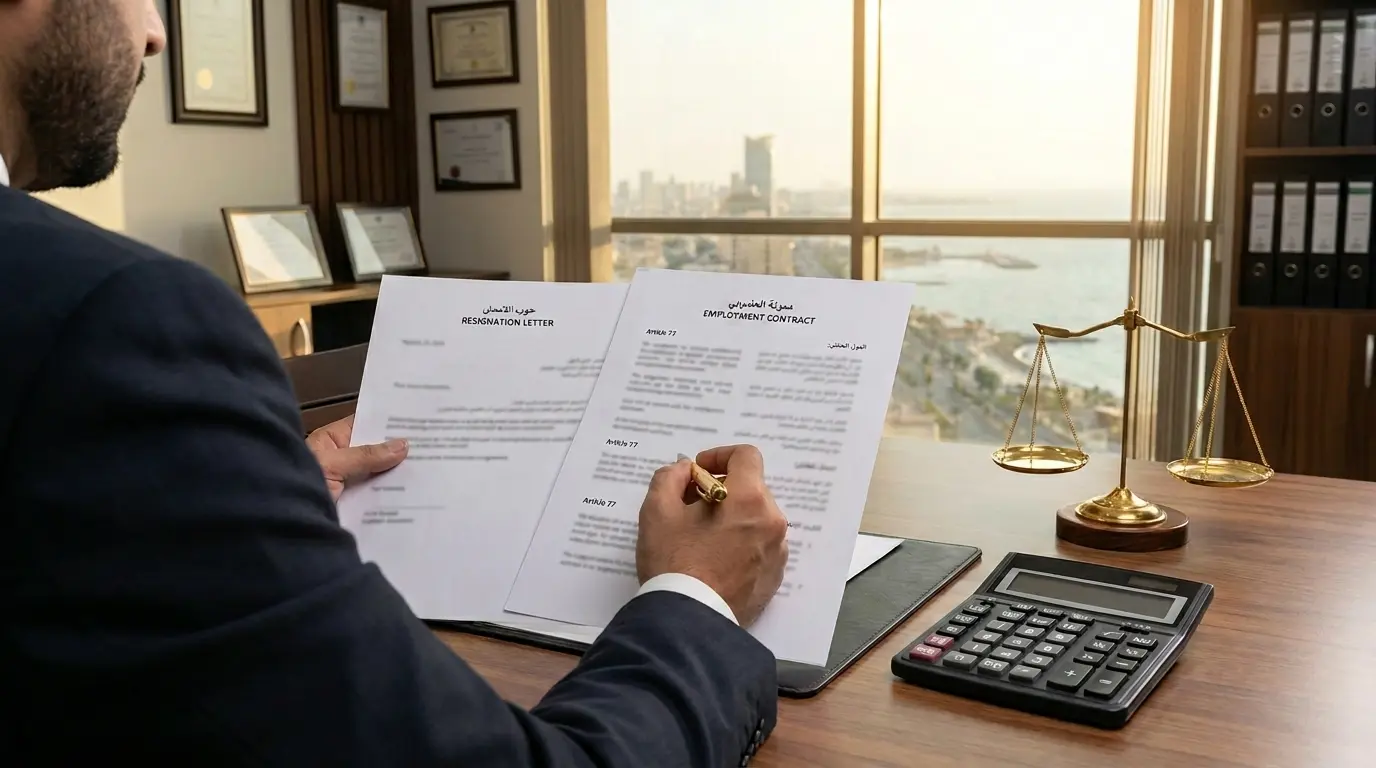
Terminating an Employment Contract Early | When Can the Company Claim the Penalty Clause?
Terminating an employment contract before its expiration is one of the most thorny labor issues that disrupts company stability and raises employee concerns. When an employee decides to suddenly resign and leave before the end of their concluded contract, the company faces the loss of a crucial human resource and operational disruption. Here, the utmost importance of the penalty clause in employment contracts emerges. Does the company actually have the right to compel the employee to pay the remaining months' salaries? And what is the legal position if the termination was justified? In this article, the labor experts at Mahmoud Al-Shangiti Law Firm in Jeddah explain the precise legal details that guarantee the rights of both parties according to the latest amendments to the Labor Law for 2026.
The Statutory Framework for Contract Termination: What Does Article 77 Say?
The Saudi Labor Law has brilliantly balanced the interests of the employer and the worker. The primary reference for any compensation regarding terminating an employment contract before its expiration for an illegitimate reason is "Article 77". This article stipulates that the harmed party has the right to claim financial compensation.
If the employment contract includes a "penalty clause" specifying a certain amount or a clear compensation mechanism upon early termination, this clause is binding on both parties (provided it is not arbitrary). However, if the contract does not stipulate specific compensation, the system intervenes by imposing default compensation (the wage for the remaining period for fixed-term contracts, or 15 days for each year for indefinite-term contracts). For more comprehensive details on the general rule of compensation, we recommend reviewing our primary reference: Guide to Penalty Clauses in Saudi Contracts 2026.
When Is the Company Actually Entitled to Claim the Penalty Clause?
The company legally has the right to activate the penalty clause and claim financial compensation from the employee in the following cases:
- Resignation without a legitimate cause: If the worker suddenly leaves work before the expiration of the contract (fixed-term) without a compelling statutory justification.
- Failure to adhere to the notice period: In indefinite-term contracts, if the employee resigns and leaves immediately without working during the stipulated "notice period" (usually 60 days), they are obligated to pay the company compensation equivalent to their wage for the notice period.
- Breach of the training costs recovery clause: If the company spent money to qualify the worker, and the contract stipulates their obligation to work for a certain period after training, otherwise they must refund the costs, then this clause is enforceable.
Cases Where the Company's Right to the Penalty Clause is Forfeited
The company cannot use the penalty clause as a sword hanging over the employee's neck under all circumstances. The system guarantees the employee the right to terminate the contract without paying any compensation in specific cases, summarized in the following table:
| Statutory Case | Description and Legal Position | Company's Entitlement to Penalty Clause |
|---|---|---|
| Application of Article (81) of the Labor Law | If the employee resigns due to the company's breach of its obligations (e.g., delaying salaries, or assigning work fundamentally different from what was agreed upon). | The company's right is completely forfeited, and the employee has the right to claim their full end-of-service benefits. |
| Probation Period (Article 53) | Terminating the contract during the probation period (which can reach 180 days) if the contract grants the employee the right to terminate. | The company has no right to claim the penalty clause; termination occurs without compensation. |
| Force Majeure | If the employee is forced to leave work due to circumstances beyond their control (debilitating illness, forced deportation, etc.). | The penalty clause is not due due to the lack of free will in the violation. |
How Do You Proactively Protect Your Company from Sudden Employee Resignations?
The biggest mistake HR departments make is relying on standard employment contract templates that do not include explicit clauses for compensation or the protection of trade secrets. Protecting your establishment's stability starts with airtight contract drafting. Through our Contracts and Consulting service, we draft professional employment contracts that include statutory penalty clauses, non-compete clauses, and qualification cost recovery, to ensure your talents do not slip away without fair compensation.
If a dispute has already occurred and the employee refuses to pay the due compensation or resorts to the judiciary to claim their dues, our team in the Litigation and Arbitration department is fully prepared to represent your company before labor courts with strength and firmness to ensure the activation of penalty clauses and the recovery of the establishment's rights.
Are you facing a labor dispute due to a sudden resignation or employee layoff?
Do not waive your company's rights, and do not accept the loss of your dues as a worker. Labor disputes require swift legal action before the statutes of limitations expire. Contact the labor case experts at Mahmoud Al-Shangiti Law Firm in Jeddah now to get a precise consultation and draft lawsuit statements that guarantee the protection of your legal and financial position.
⚖️ Request Your Labor Consultation Now to Secure Your Rights