
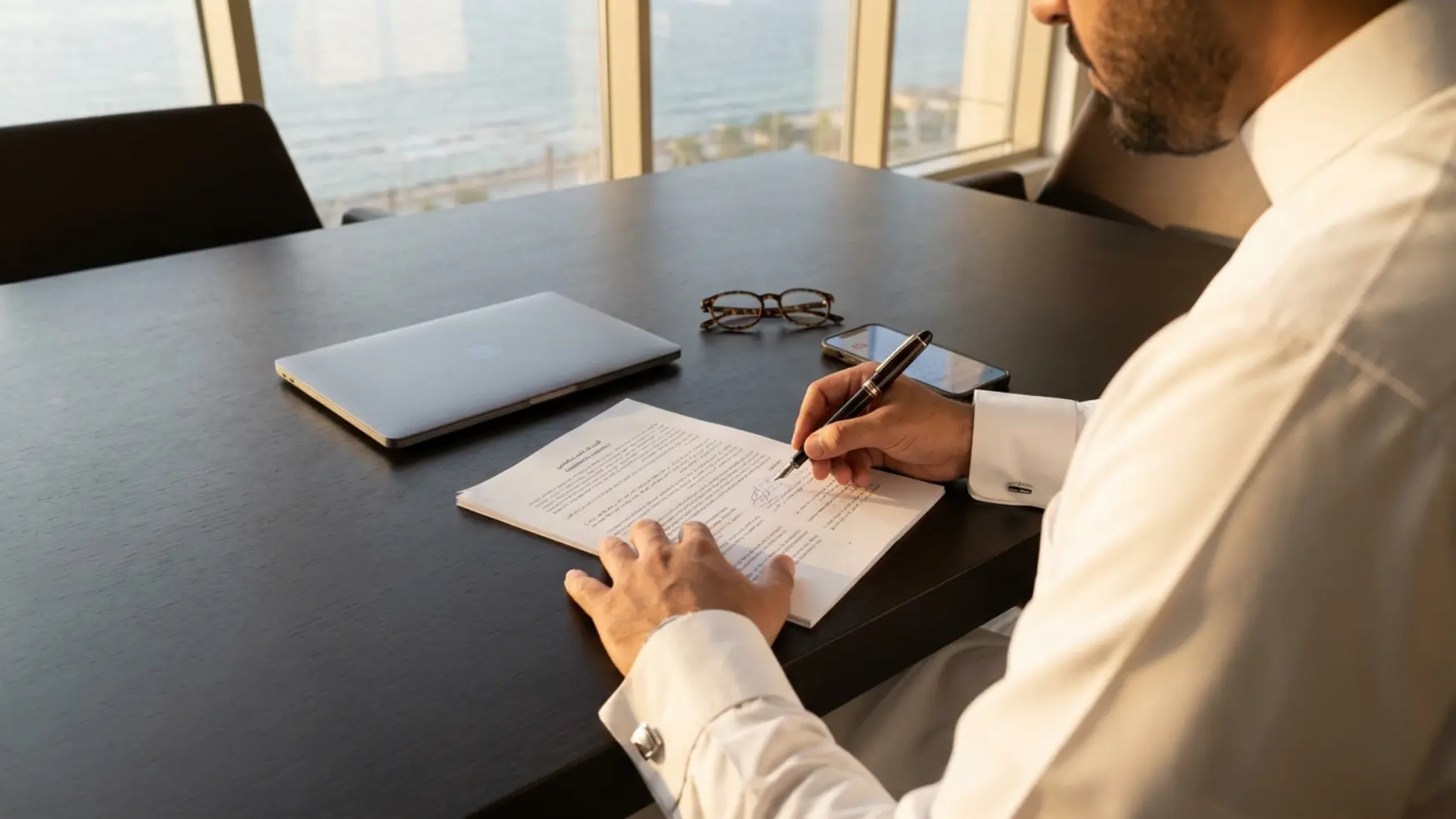
Drafting Commercial Contracts in Saudi Arabia 2026: Pillars & Risk Management
In the fast-paced business world, mutual trust and a handshake are no longer enough to guarantee rights and business sustainability. Drafting commercial contracts in Saudi Arabia is the fundamental pillar upon which any successful partnership or deal is built, especially after the qualitative leap brought about by the issuance of the Civil Transactions Law. Many commercial disputes that cost companies millions of Riyals and lead to project disruptions stem primarily from fatal loopholes in contract drafting and reliance on ready-made templates that do not fit the nature of the deal. In this comprehensive guide, the experts at Mahmoud Al-Shangiti Law Firm in Jeddah lay out an integrated roadmap on the pillars of contracts, the most prominent legal loopholes, and how to manage risks to ensure the protection of your company in 2026 and beyond.
The Statutory Foundation: The Contract is the Law of the Contracting Parties Under the Civil Transactions Law
The Saudi Civil Transactions Law established the principle that "the contract is the law of the contracting parties," meaning that what is agreed upon in writing becomes the governing law for the relationship between the parties, and it cannot be revoked or amended except by mutual agreement or for reasons established by law. The law emphasizes the necessity of executing the contract according to its contents and in a manner consistent with what "good faith" requires.
However, for the contract to acquire this binding force, contract drafting in Saudi Arabia must be meticulously observed, ensuring that no clause contradicts the mandatory texts in the law, Islamic Sharia, or public policy; otherwise, the clause (or the entire contract) is considered absolutely null and void.
Pillars of a Valid Commercial Contract
For a commercial contract to be effective and produce its legal effects before commercial courts, it must contain three indispensable main pillars:
- Consent (Al-Rida): The mutual agreement of both parties' wills (offer and acceptance) free from any defects such as coercion, deceit (fraud), or gross inequity. Precise drafting ensures documenting this consent with absolute clarity by determining the capacity of the signatories and their legal authority to represent their companies.
- Object (Al-Mahal): This is the subject of the contract (the service provided, the goods sold, or the project executed). The object must be possible, determined in a way that negates gross ignorance, and lawful (not contrary to public policy).
- Cause (Al-Sabab): This is the motive or purpose of contracting, and the cause must be lawful.
Why Are Ready-Made Templates a "Trap" That Destroys Companies?
One of the biggest mistakes made by startups and even medium-sized companies is resorting to search engines to download ready-made commercial contract templates and fill in the blanks. These templates are often drafted based on the laws of other countries, or contain general clauses that do not cover the specific operational and financial risks of your project.
Professional drafting is not merely arranging words; it is legal engineering that anticipates the dispute before it occurs and sets solutions for it. Through our Contracts and Consulting service, we tailor the contract to the exact measure of your commercial deal, taking into account the most precise details concerning the nature of the industry and the obligations of the parties.
The Most Prominent Fatal Legal Loopholes in Commercial Contracts and How to Avoid Them
In the corridors of commercial courts, loopholes that destroyed major partnerships are revealed. The following table summarizes the most dangerous of these loopholes, their impact, and the optimal legal solution to plug them during drafting:
| Legal Loophole (in weak contracts) | Resulting Risks Upon Dispute | Professional Solution (Precise Drafting) |
|---|---|---|
| Absence or Ambiguity of "Dispute Resolution" Mechanism | Losing years in courts and conflicts over spatial jurisdiction, freezing the company's funds. | Explicitly stipulating recourse to arbitration or definitively specifying the court with spatial and subject-matter jurisdiction. |
| Vague "Force Majeure" Clauses | The other party exploiting normal circumstances to evade their obligations under the pretext of force majeure. | Exclusively defining force majeure events and setting a clear mechanism and timeframe for immediate notification. |
| Neglecting "Confidentiality and Non-Compete" Obligations | Leaking the company's trade secrets to competitors or the partner opening a competing business immediately after the contract ends. | Drafting a strict Non-Disclosure Agreement (NDA) extending beyond the contract's term, coupled with massive financial compensation. |
| Not Specifying a Clear Mechanism for "Termination and Rescission" | Project halting, the breaching party refusing to leave, and difficulty bringing in a replacement contractor or supplier. | Stipulating automatic rescission (explicit rescissory clause) upon the occurrence of specific violations without the need for a judicial ruling. |
Risk Management: Indispensable Clauses to Protect Your Company
Advanced legal drafting does not merely determine obligations (who does what and when), but focuses heavily on "what if?". Contractual risk management requires including the following clauses with unambiguous clarity:
1. Penalty Clause (Liquidated Damages)
Do not wait for damage to occur and then begin an arduous journey in the courts to prove its financial volume. It is essential to include a specific penalty clause in the contract that the breaching party is obligated to pay the moment they delay or refrain from execution. For a deeper understanding of how to draft this sensitive clause so the judge accepts it and doesn't consider it arbitrary, we advise you to refer to the Guide to Penalty Clauses in Saudi Contracts.
2. Payment Structuring and Linking to Milestones
In project management, financial risk is the primary concern. The payment mechanism must be drafted in a way that protects your company's cash flow. Do not pay massive amounts upfront based on promises; rather, the contract should be divided into phases (Milestones), and each payment is linked to receiving specific, measurable, and inspectable outputs. If you are entering into massive partnerships, our Projects department guarantees you a legal and financial structure that fully protects your investments.
3. Limitation of Liability
A vital clause to protect the company's entity from collapse. It involves agreeing to set a "maximum ceiling" for compensations that the company can be claimed for in the event of unintentional error, and excluding compensation for indirect damages (such as uncertain potential future lost profits), thereby protecting the company's budget from astronomical claims.
The Role of the Contracts Lawyer in Protecting Your Commercial Business
Investing in contract drafting is the first and strongest line of defense for your company. We at Mahmoud Al-Shangiti Law Firm in Jeddah realize that the Arabic language is vast, and a single word in a contract can change the course of an entire case. We draft and review all types of commercial contracts (supply, construction, partnerships, franchising, and commercial agencies) to ensure their full compliance with Saudi laws, and to close any loophole the opponent might exploit.
However, if you inherited weak contracts or got involved in a partnership using ready-made templates and a dispute began, our team in the Litigation and Arbitration department is ready for immediate intervention. We analyze the contract and utilize judicial precedents and the texts of the Civil Transactions Law to build an offensive and defensive strategy that guarantees the recovery of your financial and commercial rights as quickly as possible.
Are you preparing to conclude a massive commercial deal and fear contract loopholes?
Do not risk your company's future and millions of Riyals by relying on weak contracts or ready-made templates. Legal loopholes are the black hole of commercial profits. Contact the commercial law experts at Mahmoud Al-Shangiti Law Firm in Jeddah now to draft airtight, tailor-made contracts for your business that guarantee your rights and completely neutralize risks.
⚖️ Request Commercial Contract Drafting and Review Services Now