
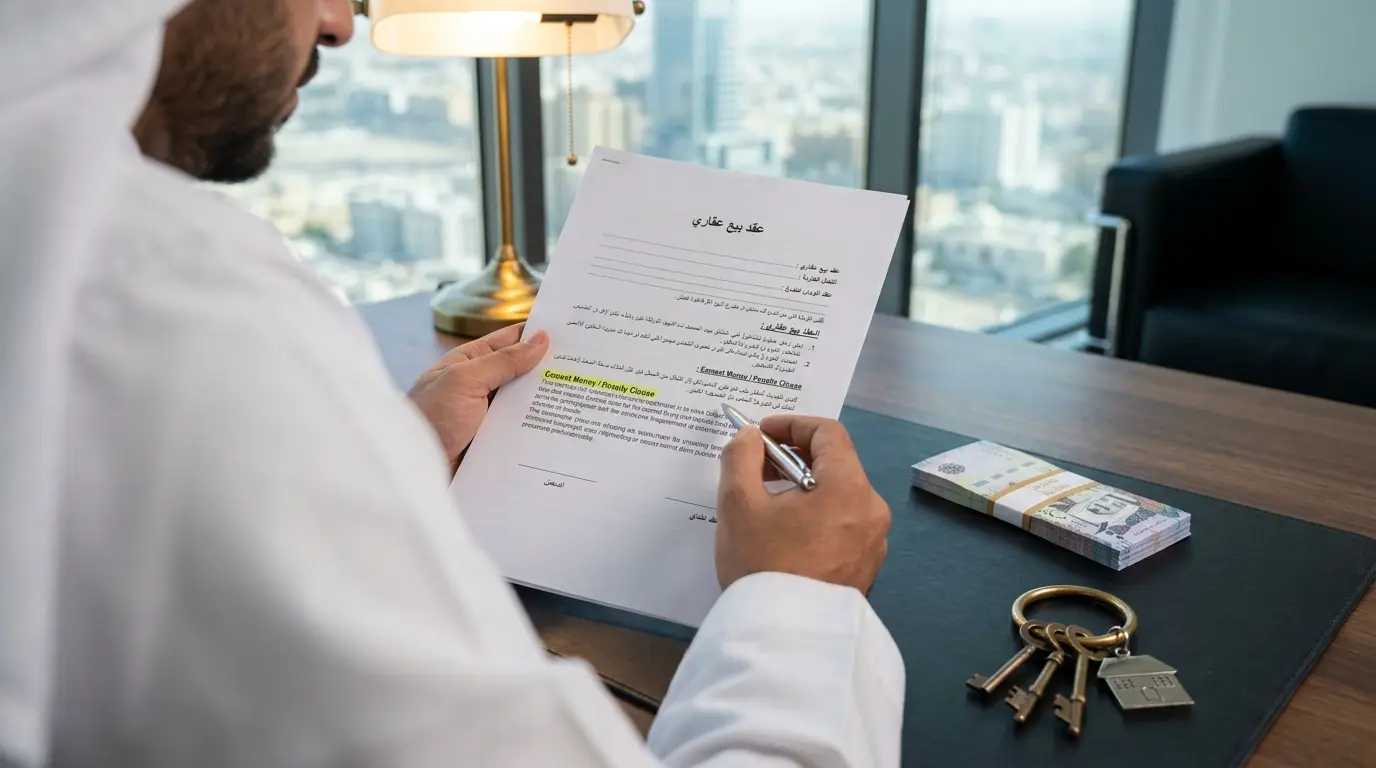
Penalty Clause in Real Estate Contracts | Earnest Money & Backing Out 2026
In the active Saudi real estate market, purchasing land or property represents a massive and fateful investment. These transactions often begin with paying "earnest money" (Arboon) and signing a preliminary contract. But what happens if one of the parties (the buyer or the seller) backs out before the final transfer of ownership (Ifrag)? Here, the role of the penalty clause in real estate contracts and the rulings on earnest money emerge. Many confuse the concept of earnest money as a down payment with its concept as a penalty clause upon retraction. In this article, the contract lawyers at Mahmoud Al-Shangiti Law Firm in Jeddah explain the decisive legal procedures to protect your money from the loss of earnest money or the other party's stubbornness.
The Fundamental Difference Between Paying Earnest Money and a Penalty Clause
To understand your legal position when one of the parties backs out of a real estate transfer, you must precisely distinguish between paying earnest money and activating a penalty clause, a matter the Saudi Civil Transactions Law has clearly settled.
Earnest Money (Indication of Finality or Retraction): The general rule in paying earnest money in contracts is that it implies "an indication of finality and confirmation," meaning the contract has become binding and cannot be retracted, and the earnest money is deducted from the property's price. However, if the contract explicitly states (or customary practice dictates) that the earnest money is a "penalty for retraction," then the earnest money takes the ruling of a penalty clause.
To delve deeper into the general rulings of agreed compensation across various sectors, we recommend reviewing our primary reference: Guide to Penalty Clauses in Saudi Contracts 2026.
The Ruling on One Party Backing Out of Transfer (Paying Retraction Penalty)
If the real estate sale contract stipulates that the earnest money acts as a penalty clause (retraction penalty), the system applies the following strict rules to settle the dispute:
| Case (Withdrawing Party) | Legal Ruling on Earnest Money (Penalty Clause) |
|---|---|
| The buyer backs out of the purchase | The buyer completely forfeits the earnest money amount to the seller as compensation for disrupting the property sale. |
| The seller backs out of the transfer | The seller is obligated to refund the earnest money to the buyer, and pay an equal amount to it (i.e., returns double the earnest money). |
| Retraction due to Force Majeure | The earnest money is refunded to the buyer and the penalty clause is not due due to the absence of fault (such as the expropriation of the property for public benefit before transfer). |
Can the Seller Be Forced to Transfer the Property?
If the contract does not stipulate that the earnest money is for retraction, and the seller backs out out of greed to sell the property at a higher price to another buyer, they do not have the right to rescind the contract by returning double the earnest money. In this case, the contract is considered binding (indication of finality), and the buyer has the right to file a "lawsuit to prove sale and compel transfer" before the General Court to force the seller to complete the transaction and transfer ownership by the force of law.
Legal Linkage: The Penalty Clause and its Intersections in Contracts
Penalty clauses are the language of business and the preservers of rights, and their rulings and applications vary from one sector to another. While the penalty clause in real estate consists of forfeiting earnest money or forcing the seller to transfer, we find that building contractors are subject to specific percentages as delay fines, which we detailed in our article Delay Fine vs. Penalty Clause in Construction Contracts.
The impact of these clauses also extends to cover damages in supply chains as we explained in The Penalty Clause in Commercial Supply Contracts. In all cases, if any party feels that the forfeited earnest money or the exaggerated penalty clause represents an injustice to them, the law has guaranteed them the right to request judicial intervention as we explained in the guide to Reducing an Exaggerated Penalty Clause.
How Do You Protect Your Money When Drafting a Real Estate Sale Contract?
Relying on real estate offices to draft contracts may drop you into the trap of weak templates that do not clearly define the nature of the "earnest money" and open a wide door for disputes and stalling. To avoid losing hundreds of thousands, you must use a Contracts and Consulting service to draft a contract that clarifies the obligations of each party and the final transfer date.
If you are currently facing stubbornness from a seller who refuses to transfer or is stalling in returning your money, our team in the Litigation and Arbitration department is ready to represent you before the courts to enforce your contractual rights.
Did the other party back out of completing the real estate deal and harm your money?
Do not forfeit your earnest money and do not accept the seller's stalling in transferring ownership. Real estate contracts bind parties under the Civil Transactions Law. Contact the contract and real estate dispute experts at Mahmoud Al-Shangiti Law Firm in Jeddah now to study the sale contract, and immediately begin procedures to demand forced transfer or recover the earnest money and compensation.
⚖️ Request Your Real Estate Consultation Now to Protect Your Money